Professional Strategies for Building Security Management
Maintaining a professional environment begins with implementing a suitable framework that monitors individual movement. As businesses in Singapore become more technologically advanced, traditional locks and keys are no longer adequate for securing offices, data centres, or industrial premises. Investing in an electronic solution not only raises protection but also provides significant convenience and administrative accountability. By utilising professional expertise, organisations can select the most appropriate security access control installations for their specific needs, ranging from card readers to biometric scanners.
A comprehensive entry mechanism is designed to regulate exactly who enters or leaves a building or a specific room. These systems verify identity through various credentials, such as numeric codes, proximity cards, or biological fingerprints. Comnet provides end-to-end solutions that cover everything from initial consultancy and installation to ongoing technical support. These systems are designed to be secure and scalable for both small local offices and large multi-site firms.
Key Takeaways:
Assess site layout and cabling infrastructure before commencing work.
Prioritise structured cabling to support long-term network efficiency.
Implement uninterruptible power supplies to prevent protection loss.
Mount hardware strategically at ergonomic heights for ease of use.
Integrate surveillance systems to create reliable visual audit trails.
Conducting Comprehensive Initial Site Surveys
The guiding principle for any professional installation is that nothing should be done by force before a thorough review of the environment is completed. Conducting a proper site survey is the first stage of the project, focusing on a detailed evaluation of the client's unique requirements. Specialists spend time assessing the property layout to identify efficient cable routes and verify if network cabling services are already in place. This initial assessment allows the team to determine the exact number of entry points and door types.
By understanding the existing electrical infrastructure, installers can avoid technical conflicts that might arise during the implementation phase. This stage also serves to decide if the new security door access control systems must integrate with secondary systems like video monitoring or intruder alarms. A well-executed site review ensures the final infrastructure is robust enough to support advanced technology without needing structural modifications later. Proper planning acts as a safeguard against performance issues and ensures the system is tailored to the building architecture.
Strategic Selection of Authentication Technologies
Choosing appropriate credentials is a primary step in procurement, as different environments require varying levels of protection. Modern door access systems are widely applied in offices where magnetic or proximity cards grant entry when tapped against a reader. These are favoured by businesses looking for a cost-effective and tested method of securing their property. However, physical cards can be easily misplaced or stolen, requiring a cycle of replacement when they become broken or damaged.
Keypad systems offer an alternative for medium-security locations, such as storerooms, by providing a numeric code that eliminates physical badges. For high-security areas like financial institutions, biometric systems utilise unique human characteristics such as fingerprints or facial recognition to verify identity. These biological traits are incredibly hard to duplicate, making them one of the safest options available. While they provide quick authentication, they often require frequent calibration and maintenance to remain accurate.
Infrastructure Cabling and Management Efficiency
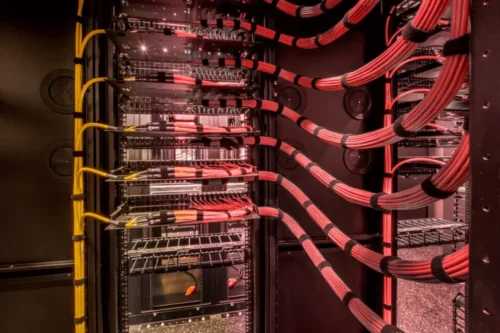
Wiring serves as the essential backbone of any digital entry setup, requiring clear routes that are kept away from electrical lines. All cables must be clearly labelled during the installation process to simplify maintenance and allow for quick fault diagnosis. A methodical approach to the cabling infrastructure prevents performance issues and ensures signals from readers reach the controller without delay. Disorganised wiring frequently leads to unsightly clutter and unstable operations within the server room.
Professional structured cabling provides an organised framework that allows for the flexible addition of new devices with minimal business disruption. Long-term scalability must be addressed from the initial design phase to prevent expensive renovations as the company expands. By applying systems with high bandwidth potential and spare capacity, firms can integrate new technology with minimal friction. Proper management within the server room also prevents messy cables from blocking vents and restricting vital airflow.
Redundancy and Power Continuity Standards
Digital hardware is entirely dependent on a stable electricity source to function correctly, making power planning a top priority. If the local grid fails, electronic locks may leave a building vulnerable or trap personnel inside during an emergency. Incorporating uninterruptible power supplies into the design ensures that readers and controllers remain active during an outage. These units also protect sensitive internal electronics from damaging power surges or electrical noise.
Routine maintenance audits should include inspecting these backup systems to ensure they remain synchronised with the primary infrastructure. Predictive maintenance identifies potential risks before they lead to unwanted downtime or system failure. For high-security data environments, a dedicated uninterruptible power supply solution provides the necessary resilience to support critical functions. Ensuring the power remains constant is a non-negotiable aspect of protecting building assets, people, and data.
Strategic Mounting and Hardware Alignment
Once the infrastructure is ready, hardware must be mounted carefully in strategic locations that maximise both security and utility. Controllers are generally installed in secure indoor locations to prevent tampering, while readers and keypads are positioned at ergonomic heights. All locks and strikes must be aligned precisely with the door frames to maintain mechanical reliability. Modern entry setups often require close integration with network equipment for real-time monitoring.
Outdoor installations require additional consideration, involving the use of weather-resistant fittings to ensure durability in exposed areas. Technicians must verify that all network cables and ducts meet the standards expected for corporate infrastructure. Proper placement ensures that the physical barrier is as secure as the digital logic controlling it. Every reader and lock must be firmly secured to withstand the rigours of daily commercial use without degrading over time.
Software Programming and Functional Validation
The transition from physical hardware to a functional system occurs during the software configuration and programming phase. Technicians create individual user profiles, assign specific permissions, and set detailed schedules for different scenarios. Accurate programming is essential to ensure the smart entry system functions exactly as intended. This establishes the logical framework that protects the property's physical assets and digital data.
Thorough testing of every component is a mandatory requirement before the system is officially handed over to the client. Every credential, whether a card, PIN, or biometric template, must be verified to confirm it grants access correctly. Technicians must also run simulations of power outages to verify that the backup power modules provide the necessary resilience. These final checks ensure that software logs accurately reflect real-world activity observed at entry points.
FAQs
1. Why is a site review necessary before starting an installation? A proper site survey evaluates the client's requirements, property layout, and existing electrical infrastructure to ensure the system is tailored to the building and avoids unnecessary modifications.
2. What role does wiring play in the stability of the system? Wiring acts as the backbone of the setup, requiring secure routing and clear labelling to prevent faults, simplify maintenance, and ensure stable communication between devices.
3. How do uninterruptible power supplies support building security? They ensure continuous operation during electrical outages, protect sensitive electronics from damage, and support critical functions to prevent system downtime in high-security environments.
4. What is involved in the software setup phase of installation? Technicians create individual user profiles, assign specific permissions, and define access schedules to ensure the system functions correctly across various scenarios.
5. How does CCTV integration enhance property security? Modern solutions integrate with CCTV systems to provide visual verification alongside access logs, capturing footage instantly when a credential is used to enhance audit trails.
Read another Article: Smart Guide To Access Control System Installation
Comments