Kenya is a destination that leaves an imprint on the traveler even after the red dust has been cleaned off the boots. It is the origin of safari, the land where contemporary civilization coexists with the ancient world, Kenya Backpacking Itinerary Guide and a place where it is possible to experience the vibrant atmosphere of a Nairobi market and then in the evening retreat to the quiet golden savanna of the Mara.
In case you had ever thought about seeing the "Big Five" in a cost-effective way, or about the possibility of traveling East Africa with nothing more than a backpack and the spirit of adventure.
Why Should You Go Backpacking in Kenya?

Kenya is a backpacking destination that will never be forgotten. The trip will offer the best of wildlife, nature, and culture all in one package. It is the paradise for those travelers who want real experiences, flexibility, and low-cost explorations.
So here is the list of reasons why Kenya should be the first place for backpackers:
- Wildlife: Get toe-to-toe in national parks Maasai Mara and Amboseli with not only the Big Five of Africa but also the diverse wildlife of those parks.
- Landscapes: The Great Rift Valley, Mount Kenya, and beautiful lakes like Naivasha and Turkana are just some of the scenic views that you will see.
- Culture: Meet and talk to the Maasai, Samburu, and others and you will learn about their way of life and customs.
- Activities: There are many activities to do such as hiking, trekking, hot air ballooning, and water sports at the coast.
- Traveling on a Budget: Backpacking provides accommodations, food, and non-stop transportation that are all very flexible and economical.
- Hidden Places: Go to discover Lamu Island, Hell’s Gate, and distant savannahs where few people ever come.
- Friendly People: Witness the Kenyan people's friendliness and love during your entire trip.
What documents do I need to travel to Kenya?
For A Smooth Kenya ETA application Process Without Disruptions, The Applicants Will Have To Submit A Few Important Documents. These Documents Mainly Serve To Confirm The Person\'s Identity And To Provide A Valid Reason For The Trip.
- Passport Bio Page: A colored photocopy of the applicant's passport showing the full bio page with a good quality photo.
- Applicant Photo: A recent photo different from the one in the passport with a light and un-distracting background, taken within 2-3 months.
- Accommodation Document or Sponsor/Hotel Letter: A document proving accommodation which can be a hotel voucher or a letter of invitation from the host.
- Airline, Cruise, or Other Booking Confirmation: A document that confirms your travel arrangements showing the dates you will be entering Kenya.
Submitting the right and trackable documents immediately propels you to the rank of Kenya ETA holder in seconds.
How Long Is Enough for a Kenya Itinerary?
Choosing the right length of your Kenya trip is a guarantee that you will not miss the country's wildlife, culture, and landscapes at their best. Here's a comprehensive guide based on the various lengths of the trip:
- Short Trip (5–7 Days): The plan is to visit one or two key national parks and probably a coastal place.
- Medium Trip (10–14 Days): Go through several parks such as Maasai Mara, Amboseli, and Lake Naivasha, with cultural activities included.
- Long Trip (3 Weeks or More): Go slowly around. Visit the non-touristy places, safaris, hiking, and communities all at one go.
- Interest-Based Planning: Change the itinerary according to the main reason for your trip, whether it be wildlife, adventure, culture or relaxation.
- Balanced Experience: A longer trip will give you a chance to explore more and have a fuller Kenyan adventure.
Where to Stay in Nairobi as a Backpacker?
In Nairobi, there are plenty of budget-friendly places that cater to the needs of backpackers looking for comfort, safety, and a social vibe. Cramming in or just simple guesthouses, you will hardly miss the ideal lifestyle of connecting with the city and the other travelers through the available options.
- Backpackers Hostels: These are perfect for both solo and group travelers, providing dorms with shared facilities, social spots, and great atmosphere.
- Guesthouses: More of a private option for keeping the budget at the same time.
- Popular Areas: The urban zones like Westlands, Kilimani, and Langata are the first choices of the backpackers because of good accessibility and close-ness to the attractions.
- Social Environment: A lot of the backpacker accommodations set up social events, thus they are very open and friendly to the new travelers.
- Convenient Location: By being close to the public transport, you are able to discover Nairobi and arrange further travel easily.
Can Backpackers Explore Kenya’s Coastline?
Indeed, backpackers are able to easily surf up the gorgeous coastline of Kenya with beaches, culture, and adventure mixed perfectly together.
- Easy to Travel: Coast of Kenya is very much connected which makes it effortless for the backpackers to trek between the towns on the coast.
- Budget-Friendly Stays: Backpackers are able to find hostels and guesthouses that are low-priced and located in close proximity to the beach.
- Beautiful Beaches: The coast is the perfect place to experience white sandy beaches and clear blue waters.
- Cultural Experiences: Participate in a cultural mix, locals’ practices, and the historical towns by the sea.
- Adventure Activities: Taking part in snorkeling, swimming, and beach walks are common among the backpackers.
- Relaxed Atmosphere: The lifestyle on the coast is relaxed which makes it the best for slow and flexible traveling.
- Local Food Options: Indulge in fresh seafood along with local coastal dishes that are budget-friendly.
What Are the Must-Try Foods While Backpacking in Kenya?
Food plays a crucial role in the backpacking adventure in Kenya as well as giving a direct contact to the local culture and everyday life. Kenyan foods are not only heavy, affordable but also common enough to be found everywhere thus making them worthy of the budget travelers moving around the country. Among the foods that must not be missed are the following:
- Ugali: The basic food prepared from maize flour, given quite commonly with vegetables, meat or stews.
- Nyama Choma: Grilled meat which is greatly loved all over Kenya and mostly consumed together with friends.
- Sukuma Wiki: A very basic and at the same time wholesome vegetable dish often served along with ugali.
- Chapati: The soft flatbread which is of Indian origin and is very much consumed in Kenya.
- Githeri: A hearty combination of maize and beans, an ideal option for economical meals.
- Mandazi: A mildly sweet deep-fried bread that is a perfect choice for breakfast or as a snack.
- Fresh Coastal Dishes: On the coastline, feast on seafood and coconut-based dishes.
Why Is It Important to Have Cultural Activities in Kenya?
Cultural activities are vital for maintaining Kenya's traditions and improving the life of the community. They are a link between people and their ancestry and also the creation of understanding and shared identity.
- Preserves Heritage: Guarantees that traditions, customs, and languages will be passed on to the future.
- Strengthens Community Bonds: Bridges the gaps between different cultures and fosters unity and respect.
- Promotes Cultural Awareness: Informs both residents and travelers about the varied lifestyles of Kenya.
- Supports Local Livelihoods: Generates income for artists, performers, and crafters.
- Enhances Visitor Experiences: Brings about genuine and significant cultural interactions.
- Encourages Sustainable Tourism: Ensures that cultural values are not only protected but also the communities get to enjoy the benefits.
What Is the Fee for the Kenya eTA?
When applying for a Kenya ETA Fees, a processing fee is required to complete your application. This fee is mandatory for approval and varies depending on your nationality and type of travel.
- Required for Processing: The eTA fee has to be paid before its approval.
- Varies by Nationality: The specific fee is determined according to the traveler's country of passport.
- Paid Online: The fee is normally paid through electronic means during the application.
- Essential for Entry: The eTA together with the payment of the fee provides the right of entry into Kenya.
- Check Updates: The fee and payment method may vary, thus always confirm before submitting your application.
- Electronic Confirmation: The eTA, once granted, is transmitted electronically for use in travel.
Where Are the Best Budget Accommodations for Backpackers?
In Kenya, budget lodgings for backpackers are quite easily found, especially in the regions where travelers frequent. These sorts of places emphasize on affordability, comfort, and convenience.
- Big Cities: Nairobi and Mombasa have a variety of hostels and guesthouses that are backpacker-friendly and are situated close to public transport and landmarks.
- Coastal Towns: The beach resorts on the coast provide affordable accommodations for a laid-back atmosphere.
- Safari Gateways: The towns next to national parks offer budget lodges and basic accommodations for the travelers.
- Guesthouses: Ideal for those seeking a private space at a lower price.
- Community Stays: These are locally operated lodgings that provide cultural immersion and are economical.
How Can Backpackers Stay Safe in Kenya?
Safety is very important when it comes to an enjoyable trip:
- Route selection should be done taking into account the popular ones only, and night travel should be avoided.
- Use trustworthy modes of transport and book the hotels in advance that are certified by the tourist board.
- Nothing of value should be left unguarded, and only a small amount of cash should be carried.
- Offering the animals the respect they deserve in national park areas is a must.
- Stay up to date in terms of local situations and health advice.
The majority of tourists regard Kenya to be a safe place as long as they adhere to simple preventive measures.
What Should You Pack for a Kenya Backpacking Trip?
Smart packing is very crucial:
- Minimalist clothes fit for the warmest days and the coolest nights.
- Boots and slippers for hiking safaris and city roaming.
- Insect repellent and malaria treatment are the musts.
- Insurance papers and passport photocopies.
- A tiny hiking bag for daily excursions, a large one for your major suitcase.
- Bring along multi-purpose stuff to cater to urban, wildlife, and coast conditions.
How Can Backpackers Travel Between Cities in Kenya?
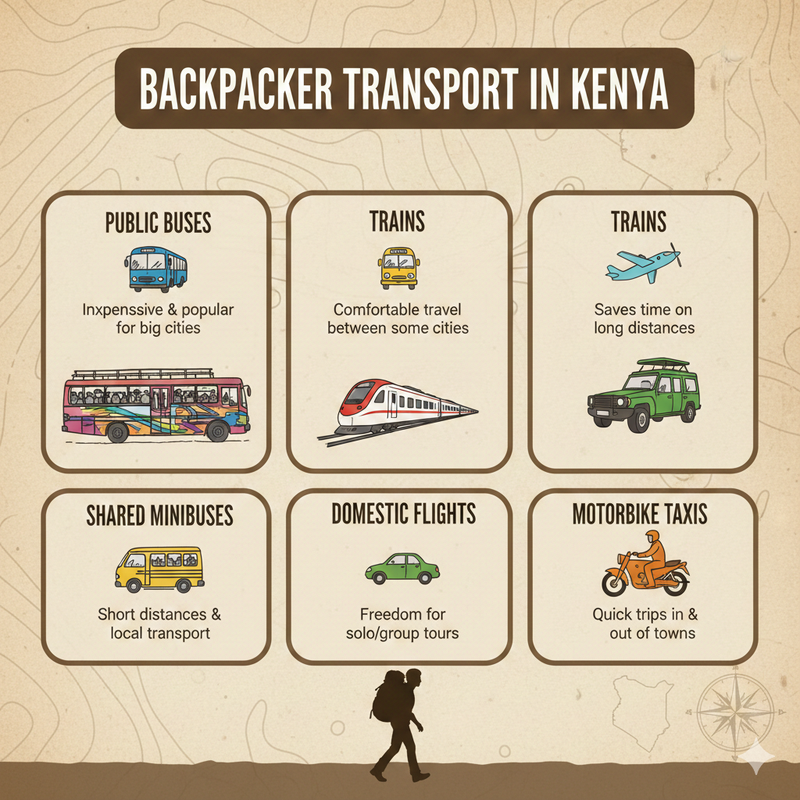
Transporting in Kenya is not very difficult for the backpackers as the transport means are cheap and flexible. The backpackers traveling for a short or long distance also have choices of their methods based on their financial and comfort situation.
- Public buses: An inexpensive and popular way of going around between big cities and towns.
- Shared minibuses: Mostly used for short-distance traveling and local transport.
- Trains: A pretty nice way of going around between some big cities.
- Domestic flights: These are good for not wasting time on long-distance roads.
- Car hire and ride sharing: For those who love the freedom of traveling solo and for group tours.
- Motorbike taxis: Good for going around quickly in and out of towns and cities you are visiting.
What Are the Top National Parks for Backpackers in Kenya?
Kenya has numerous national parks that are perfect for backpackers who want to experience wildlife, beautiful landscapes, and adventure. The parks are characterized by easy access, varied topography, and unforgettable moments.
- Masai Mara National Park: It is renowned for its large savannahs and plentiful animals.
- Amboseli National Park: It is appreciated for breathtaking views and big herds of elephants.
- Lake Nakuru National Park: It is preferred for its beautiful lake and countless birds.
- Tsavo National Parks: They provide wide-open spaces and a more peaceful safari.
- Nairobi National Park: It is remarkable for wildlife living very close to the city.
- Hell’s Gate National Park: The place for hiking, biking, and getting lost in impressive nature.
What Is the Communication Culture in Kenya?
Having an understanding of the communication culture in Kenya would be a huge advantage to the respectful and effective interactions one could have while traveling. The country is characterized by politeness, friendliness, and good verbal and non-verbal signals.
- Politeness and Respect: Greetings are very much a part of life; always be polite, and when you enter the shop or come across the locals, acknowledge them.
- Greetings: Handshakes are the usual practice, sometimes with a smile; close friends might hug or shoulder tap.
- Language Diversity: English and Swahili are the most spoken languages, while the local dialects are many depending on the area.
- Non-Verbal Communication: Eye contact, motions, and tone are all important, and the excessive confrontation is commonly avoided.
- Indirect Communication: People might use polite hints rather than outright refusals to keep the peace.
- Friendly and Social: Kenyans frequently like talking to each other, telling stories, and creating a connection before any business or serious discussions take place.
What Is the Best Time to Go Backpacking in Kenya?

The selection of the appropriate timing for going on a backpacking trip in Kenya can significantly enhance your travel experience. The weather, the state of the roads, and the number of people visiting the sites are all crucial factors in the planning of your trip.
- The dry seasons: These are the perfect times for backpacking, as the weather is nice and traveling is easier.
- Wildlife Viewing: During dry times, animals are less concealed by the thick bush and hence easier to see as they come to drink at the waterholes.
- Outdoor Activities: Great for hiking, safaris, and city tours without weather interruptions.
- Shoulder Seasons: Less tourists, more green, and a slower travel pace.
- Coastal Travel: Good weather all the time makes the beach places more fun.
- Better Planning: The right season will prevent you from being delayed and will make your trip smoother.
Conclusion
Backpacking in Kenya offers a unique combination of wildlife, culture, adventure, and coastal relaxation. By planning carefully, following safety tips, and immersing yourself in local experiences, you can create memories that last a lifetime. Use this guide to shape your own Kenya backpacking journey, balancing exploration, fun, and cultural immersion for an unforgettable adventure.
Comments